
Description
1. Introduction to BOP Housing Forgings
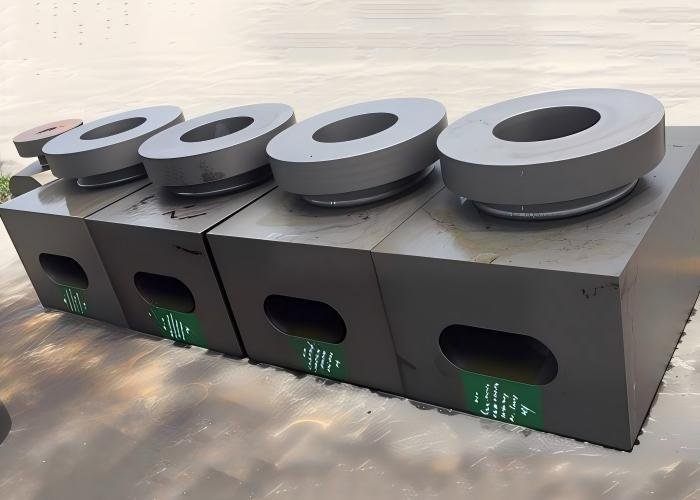
A Blowout Preventer (BOP) is a critical safety device installed on drilling rigs to prevent blowouts. The housing is its most important pressure-containing component. BOP housing forgings refer to the rough or finished housings formed by forging processes. The quality of these forgings directly determines the sealing performance and structural integrity of the entire well‑control system under high‑pressure conditions.
2. Commonly Used Materials for BOP Housing Forgings
The following material categories are typically employed:
2.1 Cr‑Mo alloy structural steels – the most widely used series. Representative grades include:
- 30CrMo – a typical choice for BOP forgings.
- AISI 4130 – the U.S. equivalent of 30CrMo, extensively used in BOP housing forgings.
- 25CrNiMo – a low‑carbon alloy steel offering high yield strength, tensile strength, and fatigue strength, while maintaining adequate plasticity and toughness.
- 35CrMo (G41350) – also applied in BOP housings, drilling spools, and other pressure‑containing components.
2.2 High‑alloy steels and stainless steels – required for severe sour‑service environments (e.g., H₂S exposure):
- ASTM A182 F6a (martensitic stainless steel)
- F55 (super duplex stainless steel)
2.3 Other optional grades – including AISI 4140, 4142, 4330 Mod, 4340 Mod, etc.
3. Why Are Forgings Preferred over Castings for BOP Housings?
As the core pressure‑containing component of well‑control equipment, the material selection for the BOP housing directly impacts the overall safety and reliability of the system. In engineering practice, forgings offer significant advantages over castings:
3.1 Material density and internal quality control
Castings are produced by liquid‑state solidification, which inevitably introduces defects such as shrinkage cavities, porosity, and gas holes, along with coarse grain structures. These internal discontinuities serve as potential failure sources under pressure. Forgings, in contrast, undergo multi‑direction plastic deformation under high‑tonnage presses, which closes and welds internal voids, refines the microstructure, and achieves a dense, defect‑free structure – inherently superior material integrity.
3.2 Mechanical properties and low‑temperature toughness
The plastic deformation during forging breaks up the coarse as‑cast dendrites, refines grain size, and aligns non‑metallic inclusions along the flow lines. This significantly enhances strength, ductility, and toughness. After appropriate heat treatment, forgings exhibit far better overall mechanical properties than castings of the same composition. In particular, they provide excellent impact toughness reserves at low temperatures, effectively reducing the risk of brittle fracture.
3.3 Safety margin under high‑pressure service
BOP housings are subjected to pressures ranging from tens to over a hundred megapascals, often accompanied by pressure fluctuations and temperature variations. This demands high fatigue resistance and fracture toughness. Forgings, with minimal internal defects and uniform properties, offer more balanced stress distribution under pressure, substantially lowering the probability of crack initiation and propagation. Thus they provide a greater safety margin, fulfilling the reliability requirements of well‑control equipment as the “last line of defence”.
3.4 Manufacturing process and economic trade‑off
The intricate internal cavities of modern high‑end BOP housings are difficult to achieve by casting alone. The current practice uses forged blanks followed by precision milling on 5‑axis CNC machining centres. Although this route costs more than three times that of casting, the safety benefits over the entire life cycle and the mitigation of accident risks far outweigh the extra expenditure. Consequently, forging is universally accepted as the standard material‑selection approach in the industry.
4. Typical Forging Process for BOP Housing Forgings
The standard process sequence is as follows:
4.1 Open‑die forging preforming (billet preparation)
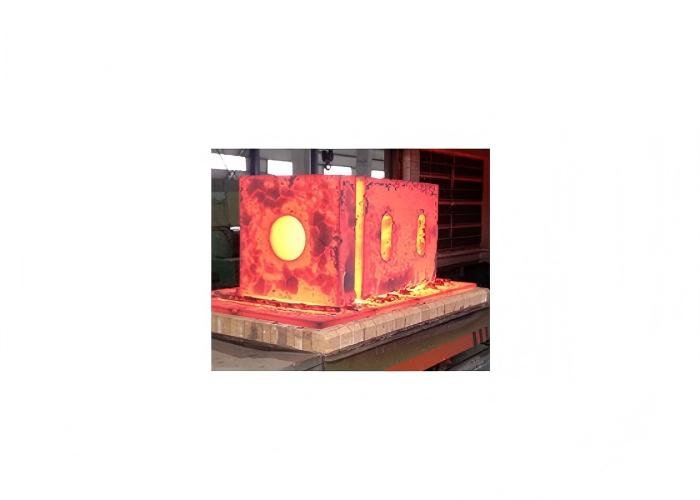
The steel ingot is heated to a high temperature (e.g., 1230 °C ± 20 °C) and held for thorough soaking, then subjected to heavy reductions through upsetting and drawing in open‑die forging. This ensures complete internal penetration and eliminates as‑cast defects.
4.2 Die forging (sizing)
The preformed billet is placed into a die for final shaping, bringing the forging closer to the finished part dimensions, reducing machining allowances, saving material, and improving productivity. Some processes employ FM (free‑from‑mandrel) forging methods or die‑forging techniques to precisely control unilateral allowances.
4.3 Post‑forging heat treatment
The formed forging undergoes normalising and tempering to relieve forging stresses, refine the grain structure, and homogenise the microstructure.
4.4 Rough machining
After heat treatment, the forging is rough‑machined to the approximate shape required by the drawing.
4.5 Quenching and tempering (Q&T)
After rough machining, the part is quenched and tempered (hardened and high‑temperature tempered) to achieve the required combination of mechanical properties.
4.6 Finish machining and inspection
Final precision machining and comprehensive quality inspections are carried out.
5. Our Company’s Advantages in Manufacturing BOP Housing Forgings
- Equipment capability – Equipped with large‑tonnage hydraulic presses and electro‑hydraulic hammers, enabling production of large‑size BOP housing forgings.
- Process technology – Mastery of the combined open‑die preforming plus die‑forging process, ensuring reliable internal quality of the forgings.
- Full‑process control – Integrated in‑house operations covering raw material selection, forging, heat treatment, rough machining, and finish machining.
- Quality assurance – All products undergo strict non‑destructive testing, and we provide material certificates and inspection reports.
- Standard compliance – Products can be manufactured and tested in accordance with international standards such as API 16A, API 6A, and NACE MR0175.
6. Non‑Destructive Testing (NDT) for BOP Housing Forgings
NDT is a critical step in quality verification. The main testing items include:
(1) Ultrasonic testing (UT) – used to detect internal defects (e.g., cracks, inclusions, shrinkage cavities). This is the most essential NDT method for forgings.
(2) Magnetic particle testing (MT) – employed for detecting surface and near‑surface cracks and discontinuities.
(3) Penetrant testing (PT) – used to reveal surface‑breaking defects.
Standard requirements:
- API Spec 16A imposes strict requirements on NDT and acceptance criteria during the manufacturing of well‑control equipment.
- Pressure‑containing parts shall undergo both surface and volumetric NDT to ensure compliance with the specified standards.
- All NDT procedures must meet the stipulations of API Spec 16A.
7. Frequently Asked Questions (FAQ) about BOP Housing Forgings
7.1 What pressure ratings can BOP housing forgings withstand?
- Conventional product pressure ratings range from 2,000 psi to 10,000 psi (approx. 14 MPa to 69 MPa).
- Some products are rated at 15,000 psi to 20,000 psi (approx. 103 MPa to 138 MPa).
- High‑end products can reach 140 MPa (about 20,300 psi).
The actual pressure‑bearing capacity depends on the design, material grade, forging process, and heat treatment condition. The BOP, as a pressure‑containing steel component, is typically subjected to hydrostatic tests of 52.5 MPa or higher.
7.2. What standards apply to BOP housing forgings?
Product design and manufacturing standards:
- API Spec 16A – the core standard for BOP equipment design and manufacture.
- API 6A – for wellhead and Christmas tree equipment, covering flange connections, bolting dimensions, etc.
Material and forging standards:
- API Spec 20B – standard specification for open‑die forgings for petroleum and natural gas industries.
- NACE MR0175 / ISO 15156 – for metallic materials in H₂S‑containing environments.
- GB/T 20174 – Chinese national standard equivalent to API 16A.
- ASTM A182 – standard for forged or rolled alloy‑steel pipe flanges, fittings, etc. for high‑temperature service.
Quality management standards:
- API Q1 – quality management system requirements for the petroleum industry.
- ISO 9001 – international quality management system standard.
7.3. What delivery conditions are available for BOP housing forgings?
| Delivery Condition | Description |
| Rough (as forged) | Original forged state without machining. |
| Rough machined | After rough machining, most of the black scale removed, with machining allowances left. |
| Finish machined | Fully machined to the drawing dimensions, ready for direct use or assembly. |
Regarding heat‑treatment states, we can supply forgings in normalised, quenched‑and‑tempered, annealed, or tempered conditions. According to API requirements, forgings are generally delivered in the normalised state as raw material. Specific delivery conditions can be customised according to customer drawings and technical requirements.


Reviews
There are no reviews yet.