
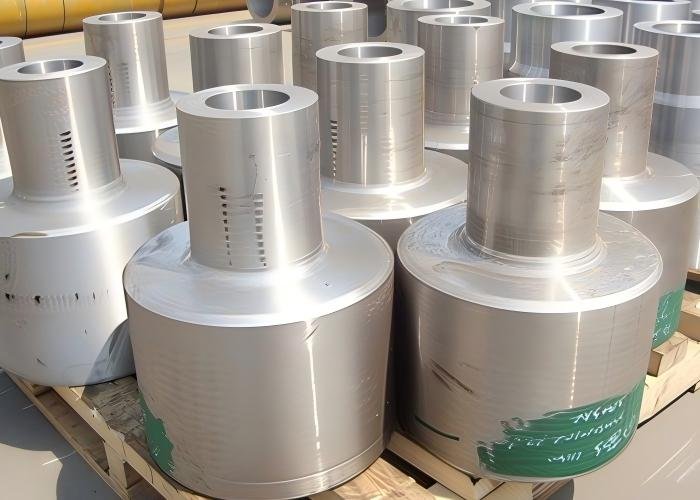
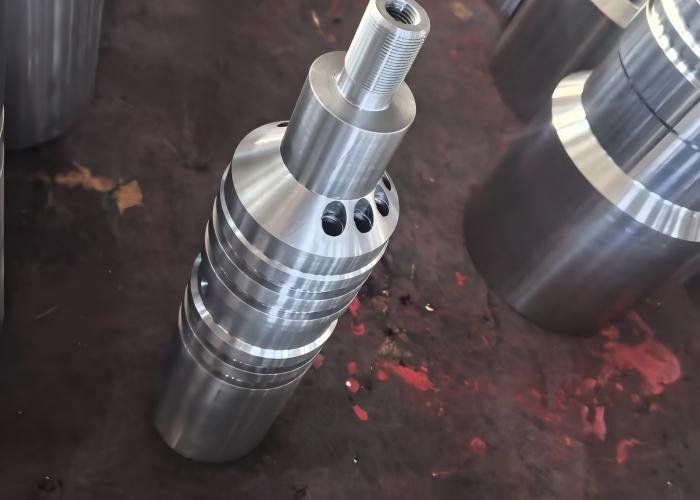
Description
1. Brief Introduction to Hanger Forgings
Hanger forgings are critical pressure‑bearing/load‑bearing forgings used in oil & gas, drilling, and wellhead equipment. They are primarily employed to suspend casing, liner, and tubing strings, supporting the self‑weight of the pipe string, wellhead pressure, downhole impact, and corrosive loads. As key structural components connecting the wellhead and downhole tubulars, they must exhibit high strength, high toughness, fatigue resistance, corrosion resistance, and reliable sealing performance – making them fundamental to the safe and long‑term stable operation of oil and gas wells.
2. Applications of Hanger Forgings
- Wellhead equipment: Casing hangers and tubing hangers – used to suspend the casing/tubing string in the well, seal the annulus, and withstand high wellhead pressures (up to 70 MPa+).
- Liner hangers: Used in deep wells, ultra‑deep wells, and horizontal wells to suspend liners, enabling staged production and cementing operations.
- Subsea/offshore production: Subsea wellhead hangers – designed for deep‑water high‑pressure, low‑temperature, and highly corrosive environments.
- Special service conditions: Sour oil/gas wells containing H₂S, CO₂, and Cl⁻; high‑pressure high‑temperature (HPHT) wells; and ultra‑deep wells (6000 m+).
3. Commonly Used Materials for Hanger Forgings
- 4130 (30CrMo): Per API 5CT and ASTM A29 – strength 415–900 MPa, good weldability and low‑temperature toughness, used for conventional wells and medium‑low pressure scenarios.
- 42CrMo: After quenching and tempering, tensile strength ≥1080 MPa, yield strength ≥930 MPa – high strength and toughness, suitable for medium‑high pressure and moderately corrosive environments.
- 35CrMo, 30CrNiMo8: Higher strength and hardenability, used for deep‑well and heavy‑load hangers.
4. Why Forging Instead of Casting for Hangers?
4.1 Core Performance Superiority (Safety First)
Dense structure, defect‑free: Forging compacts the metal, eliminates porosity, shrinkage, and inclusions, refines the grain, and creates continuous flow lines aligned with the principal stress direction. Castings are prone to internal defects, stress concentration, and cracking.
Substantially higher strength and toughness: Tensile/yield strengths are 30–50% higher than castings of the same alloy; impact toughness and fatigue life are significantly improved, enabling the part to withstand 70 MPa+ pressure and repeated impact loads.
Reliability and safety: Forgings have uniform, predictable properties with no hidden casting defects – making them the only safe choice for high‑pressure, heavy‑load, and corrosive wellhead applications.
4.2 Process Adaptability
Hangers are typically rotational/symmetrical structures, making forging well‑suited for near‑net shape forming, requiring less subsequent machining and achieving high precision. Casting is better for complex internal cavities, but cannot meet the performance requirements of hangers.
5. Manufacturing Process of Hanger Forgings
5.1 Raw Material Preparation
Material selection (4130, 42CrMo, etc.) → cutting (sawing/shearing) → non‑destructive testing (UT/MT to ensure billet integrity).
5.2 Forging (Core Process)
Heating: Carbon/low‑alloy steels 1150–1250℃, nickel‑base alloys 1050–1150℃ – uniform soaking.
Forging: Open‑die forging / closed‑die forging / insert‑die forging, hot‑worked to near‑net shape, with final forging temperature controlled (carbon steel ≥800℃, alloy steel ≥900℃) to ensure grain refinement and continuous flow lines.
Cooling: Air cooling / furnace cooling / slow cooling to avoid cracking and residual stress.
5.3 Heat Treatment (Performance Critical)
Carbon/low‑alloy steels: Quenching and tempering – to obtain high strength combined with high toughness.
Nickel‑base alloys: Solution treatment + ageing – to precipitate strengthening phases, enhancing strength and corrosion resistance.
5.4 Rough and Finish Machining
Rough turning → semi‑finish turning → finish turning (internal bore, external diameter, seal grooves, slip grooves) → drilling/milling (threaded holes, locating holes) → grinding (sealing faces, mating surfaces) – ensuring dimensional accuracy and surface quality.
5.5 Inspection and Acceptance (Full‑Process Quality Control)
Non‑destructive testing: UT (internal defects), MT/PT (surface cracks), hardness testing.
Mechanical/physical tests: Tensile, impact, metallographic examination, chemical composition analysis.
Dimensional inspection: CMM, callipers, gauges – conforming to drawings and standards.
Pressure/seal testing: High‑pressure hydrostatic/pneumatic testing to verify pressure‑bearing and sealing performance.
6. Types of Hanger Forgings We Can Produce
- Casing hanger forgings: Sizes 7″, 9‑5/8″, 13‑3/8″, 18‑5/8″, 20″, etc., to suit various well diameters.
- Tubing hanger forgings: Sizes 2‑7/8″, 3‑1/2″, 4‑1/2″, 5‑1/2″, etc., for tubing string suspension.
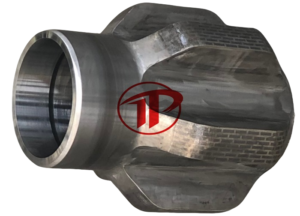
- Liner hanger forgings: Double‑cone, single‑cone, hydraulic‑set, mechanical‑release designs, etc., for deep/horizontal wells.
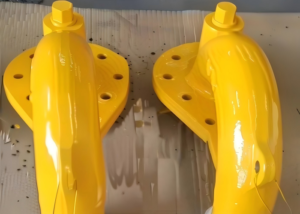
- Special hangers: Subsea wellhead hangers, sour‑service hangers, HPHT hangers.
7. Our Advantages in Producing Hanger Forgings
7.1 Full‑Process Integrated Capability
In‑house control from raw material procurement → forging → heat treatment → machining → inspection → finished product delivery – no external subcontracting gaps, ensuring stable quality and reliable lead times.
Equipped with 1000–5000 ton forging presses, high‑precision CNC machining centres, fully automated heat‑treatment furnaces, and professional physical/chemical and NDT laboratories.
7.2 Material and Process Expertise
Years of experience in oil & gas forgings, with deep know‑how in forging and heat‑treating carbon steels, low‑alloy steels, nickel‑base alloys, and duplex steels – capable of consistently producing high‑end alloy hangers such as Inconel 718 and 625.
Near‑net shape forming technology reduces machining allowances, improves material utilisation, and increases production efficiency.
Strict compliance with API, NACE, and ASTM standards; key process steps are fully documented and traceable.
7.3 Quality and Certification Assurance
Full‑process UT, MT, PT, hardness, tensile, and impact testing – 100% qualified before dispatch.
We deliver zero‑failure, long‑life hanger solutions for 6000 m+ ultra‑deep wells, 70 MPa high‑pressure wells, and sour gas wells.
8. Applicable Standards for Hanger Forgings
API 6A: Specification for wellhead and Christmas tree equipment – the primary design and performance standard for hangers.
API 20B: Carbon and low‑alloy steel seamless forgings for oil and natural gas – for carbon/low‑alloy steel hangers.
NACE MR0175 / ISO 15156: Materials for use in H₂S‑containing environments in oil and gas production – mandatory for sour‑service hangers.



Reviews
There are no reviews yet.