
Description
1. What is a forged cylinder
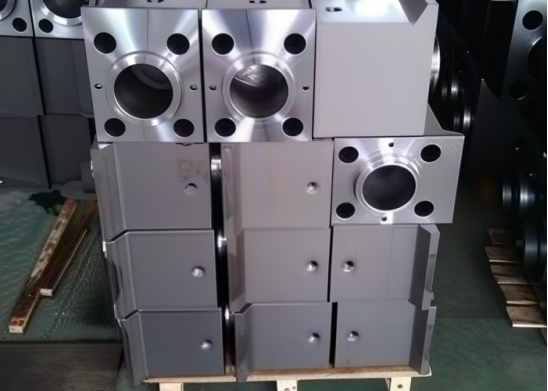
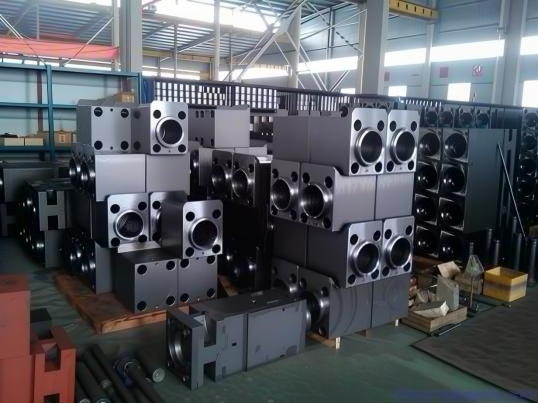
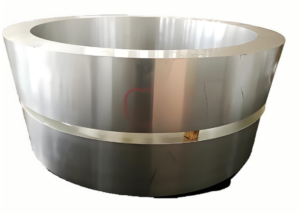
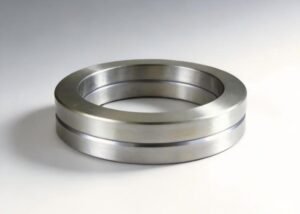
Forged cylinder is a cylinder-type forging made by pressing a metal billet with a forging machine that causes the metal to be plastically deformed in its solid state to obtain the desired shape and mechanical properties. In the process
2. Common materials used by forging plants to produce forged cylinders
2.1 Carbon steel
Features: Low cost, good machinability, moderate strength, but poor corrosion resistance.
Common grades: Q235, 45 steel
2.2 Alloy steel
Features: Alloying elements (Cr, Mo, Ni, etc.) are added to improve strength, toughness, and high-temperature resistance.
Common grades: 40Cr, 42CrMo, 30CrMnSi, AISI 4130/4140, 27SiMn, 34CrMo4
2.3 Stainless steel
Features: Strong corrosion resistance, suitable for harsh environments, but relatively high cost.
Common grades: 304/316, 17-4PH (0Cr17Ni4Cu4Nb)
2.4 Aluminum alloy
Features: Meets lightweight requirements, but relatively lower strength.
Common grades: 6061, 7075, A356-T6 (used for lightweight engine applications)
2.5 Other special materials
Titanium alloy: High strength, corrosion resistant, used in high-end aerospace and aviation fields.
Tool steel (e.g., Cr12MoV)
3. Application fields of forged cylinder
The use of forged cylinders is not limited to only heavy industries that require high strength and precision.
Some targeted uses are:
- Petroleum machinery: High-pressure cylinders for oil drilling equipment, cylinders for downhole tools, etc.
- Marine machinery: Hydraulic system cylinders for ships, steering gear cylinders, etc.
- Wind power equipment: Hydraulic pitch system cylinders for wind turbines, etc.
- Chemical equipment and pressure vessels: Shell cylinders for reactors, heat exchangers, hydrogenation reactors, and other pressure vessels.
- Metallurgy and mining: Hydraulic cylinders for rolling mills, cylinders for crushers, etc.
- Aerospace and aviation: Aircraft engine cylinders, hydraulic cylinders for landing gear, etc.
4. Core manufacturing processes for forged cylinders
The manufacturing processes for forged cylinders are mainly divided into open-die forging and multi-directional forging (precision forging), with specific process routes selected based on product structure and technical requirements.
4.1 Open-die forging
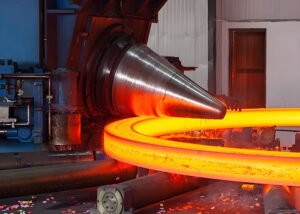
Open-die forging offers high flexibility and is suitable for large forgings in variety, small batches. It uses a multi-pass open-die punching and forming method, achieving pre-punched blind holes and mechanical blind hole expansion with variable-diameter punches, ensuring fiber flow integrity and dimensional reliability.
4.2 Multi-directional forging
For complex-shaped cylinder parts (e.g., with bosses, bottomless, or with side flanges), the multi-directional forging approach achieves near-net shape while ensuring internal quality, resulting in a more rational metal flow distribution.
5. Advantages of producing forged cylinders at our company – TIPTOP FORGING
As a professional manufacturer of forged cylinders, our company has the following significant advantages:
5.1 Strong production capacity
We have large forging equipment such as 8,000-ton and 12,500-ton oil presses, as well as 5-ton and 8-ton electro-hydraulic hammers, enabling production of various forgings up to 120 tons, with extensive experience in precision forging.
5.2 Complete full-process manufacturing capability
We possess integrated production capabilities from raw material receiving, open-die forging / closed-die forging, rough machining, heat treatment, finish machining, to final inspection – achieving in-house closed-loop manufacturing with fully traceable product quality.
5.3 Flexible delivery options
We offer various delivery conditions: rough blank, rough-machined, finish-machined, etc., to meet different customer requirements. Our products are widely used in construction machinery, petroleum machinery, marine machinery, wind power equipment, chemical equipment, pressure vessels, metallurgy, and other industries.
5.4 Export capabilities and international service
Our products are exported to the Middle East, Russia, North America, Europe, and many other countries. We have the ability to handle export orders and can design forgings according to customer drawings, samples, or functional requirements.
6. Advantages of forged cylinders compared to cast cylinders
There are fundamental differences in process principles and product performance between forging and casting. Casting is a liquid-state forming process: metal is melted and poured into a mold to solidify and take shape. Forging is a solid-state forming process: pressure is applied by forging machinery to cause plastic deformation of the metal billet. As a result, forged cylinders are significantly superior to cast cylinders in the following aspects:
6.1 Denser internal structure
Forging eliminates casting defects such as porosity, gas holes, sand inclusions, shrinkage cavities, and non-metallic inclusions that occur during the smelting process, refining the metal grains and making the internal structure more compact.
6.2 Superior mechanical properties
The mechanical properties of cast parts are lower than those of forgings of the same material. Forgings have better continuity of metal fiber structure, density, mechanical properties, and service life. The impact resistance of forged parts is 30-50% higher than that of cast parts, and fatigue life is longer.
6.3 Unbroken metal flow lines
Forging ensures the continuity of the metal fiber structure, keeping the fiber flow lines consistent with the forging’s external shape. This results in complete metal flow lines, ensuring good mechanical properties and a long service life. In contrast, the internal structure of cast parts is less uniform, and it is difficult to form continuous metal flow lines.
6.4 Suitable for high-pressure applications
For high-pressure hydraulic cylinders with operating pressures above 30 MPa, the internal quality of cast steel parts cannot meet the design pressure requirements. Forged cylinders can withstand higher working pressures and more severe operating conditions.


Reviews
There are no reviews yet.