

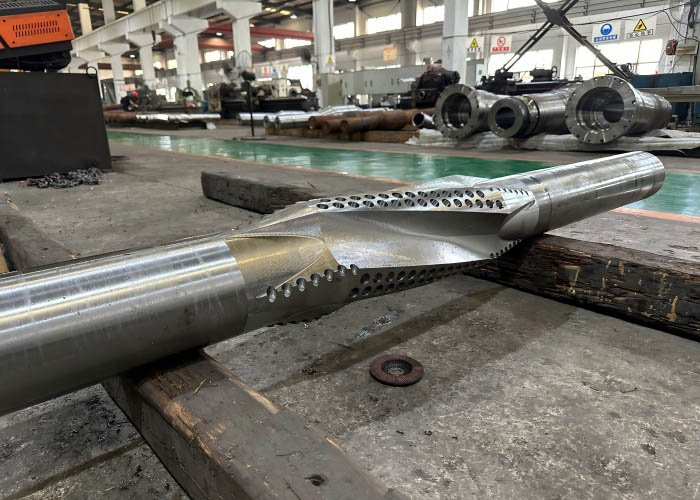
Description
1.4330V Stabilizer Forgings Introduction
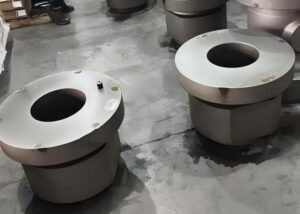
4330V (AISI 4330V) is a Ni-Cr-Mo-V low-alloy, high-strength forging material. It is modified by vanadium grain refinement and is a dedicated forging base material for high-end rigid Stabilizer bodies in oil drilling. 4330V Stabilizer forgings are integrally forged, unlike welded assembly structures. The whole part is a one-piece forged blank, which is subsequently machined into a Stabilizer body. It can be hardfaced with a cemented carbide wear-resistant layer. It is mainly used for drillstring rigid Stabilizers, near-bit Stabilizers, rotating Stabilizers, and other downhole tool bodies. It is suitable for deep wells, ultra-deep wells, directional wells, and harsh high-impact conditions. It replaces conventional 4145H forgings and solves pain points such as insufficient core toughness in large cross-sections and easy cracking under impact.
2.Applications of 4330V Stabilizer Forgings
2.1 Directional/horizontal wells: near-bit Stabilizers and drillstring rigid Stabilizers bear alternating impacts and borehole wall friction, ensuring wellbore trajectory stability in build-up and hold sections.
2.2 Deep and ultra-deep wells: under downhole high-temperature and high-stress conditions, large-size Stabilizer bodies and large cross-sections require through-hardening to prevent downhole fracture failure.
2.3 High-load complex formations: drilling in gravel and hard rock formations bears severe impact loads, reducing the risk of tool body cracking.
2.4 Low-temperature oil and gas wells: maintaining high impact toughness in low-temperature environments avoids the risk of low-temperature brittle fracture.
3.What Are the Material Characteristics of 4330V?
4330V is a Ni-Cr-Mo-V quenched-and-tempered high-strength alloy steel with relatively low carbon content. Vanadium is added for grain refinement, and VAR vacuum remelting can be used to improve cleanliness.
Chemical composition (wt%):
C: 0.28–0.33; Si: 0.20–0.30; Mn: 0.75–1.00; Cr: 0.75–1.00; Mo: 0.35–0.50; Ni: 1.65–2.00; V: 0.05–0.10; P ≤0.015; S ≤0.005.
Core material performance characteristics:
- Hardenability: Ni-V gives uniform properties in large sections. Large stabilizer cores stay strong and tough—no soft center.
- Strength/toughness: Quench and temper gives high strength with good ductility. Resists cracking, impact, and fatigue.
- Low-temp impact: CVN stays high in cold conditions. Lower brittle fracture risk.
- Weldability: Lower carbon than 4145H. Less hardfacing crack risk and a wider process window.
- Microstructure: V limits grain growth. Quench and temper gives uniform tempered martensite/bainite. Low impurities reduce inclusion failures.
- Typical Q&T properties (135–150 ksi): YS ≥931 MPa, TS ≥1030 MPa, El ≥14%, RA ≥45%, RT KV ≥65 J.
4.Manufacturing Process for 4330V Stabilizer Forgings
4.1 Complete process flow: raw material smelting → ingot casting / continuous casting → pre-forging preheating → forging → post-forging slow cooling → normalizing pretreatment → quenching and tempering (quenching + high-temperature tempering) → rough machining → nondestructive testing → finish machining → performance re-inspection → finished product.
4.2 Smelting and refining: electric arc furnace + LF secondary refining + VD vacuum degassing. High-end batches use VAR vacuum arc remelting. Harmful impurities S and P are strictly controlled, and the nonmetallic inclusion rating is reduced.
4.3 Pre-forging heating: slow and uniform preheating; forging temperature range 1065–1235°C; final forging temperature ≥850°C to avoid forging cracks. Forging ratio ≥3:1, and ≥4:1 for high-requirement products, to break up the as-cast structure and make flow lines conform to the part contour.
4.4 Controlled slow cooling after forging: ash cooling / pit cooling. Air cooling or rapid cooling is strictly prohibited to prevent cracks and excessive residual stress in forgings.
4.5 Preliminary heat treatment (normalizing): refine grains, eliminate forging stress, and prepare the microstructure for quenching and tempering.
4.6 Quenching and tempering (quenching + tempering): precisely controlled quenching and high-temperature tempering to obtain a tempered martensite/bainite microstructure. Hardness range and cross-section hardness difference are strictly controlled to ensure uniform internal and external mechanical properties. This is the most critical process for Stabilizer forgings.
4.7 Machining: rough machining removes allowance, then finish machining forms the Stabilizer body profile, flow channels, and connection thread datums.
4.8 Nondestructive testing: UT ultrasonic inspection and MT magnetic particle inspection to check internal shrinkage cavities, laminations, and surface crack defects. ASTM E45 inclusion rating is performed.
4.9 Physical and chemical re-inspection: sampling tests for tensile, impact, and hardness; material reports are retained to achieve material traceability.
5.What Advantages Does 4330V Have over 4145H in Stabilizer Applications?
4145H is the mainstream traditional material for oilfield Stabilizers; 4330V is an upgraded high-end material. Comparison:
Stronger hardenability in large cross-sections: 4330V contains Ni + V alloys, so the core strength and toughness of large-diameter Stabilizer forgings degrade very little. Large-size 4145H forgings tend to lose core toughness and are only suitable for small- and medium-cross-section Stabilizers.
Better impact toughness and crack propagation resistance: at the same strength grade, 4330V has higher room- and low-temperature impact energy. Under downhole alternating impact and vibration conditions, the body’s crack resistance and fatigue resistance are better than those of 4145H, reducing the risk of Stabilizer body fracture and falling into the well.
Better welding and hardfacing performance: its carbon content is lower than that of 4145H, so hot-cracking susceptibility is lower during cemented carbide hardfacing on Stabilizer blade surfaces. Overlay bond quality is more stable, reducing scrapping due to base metal cracking after hardfacing.
Stronger adaptability to low-temperature conditions: 4330V has a higher retention rate of low-temperature impact energy. In extremely cold regions or low-temperature wellbore environments, its brittle fracture resistance is significantly better than that of 4145H.
Finer and more stable microstructure grains: vanadium pins grain boundaries, and grains are refined after heat treatment. Microstructure uniformity is good, and the upper limit of tool service life is higher.
Drawbacks: 4330V alloy cost is higher than that of 4145H; for ordinary shallow wells and medium/small load conditions, 4145H still has a cost-performance advantage.
6.Advantages of TIPTOP ‘s 4330V Stabilizer Forgings
6.1 Source control of material: we can provide two process options—EAF-LF-VD conventional smelting or VAR vacuum remelting. Harmful elements S and P are strictly controlled, nonmetallic inclusions meet high-level ASTM E45 requirements, and material reports are complete and traceable.
6.2 Controllable forging process: forging ratio, forging temperature, and post-forging slow cooling process are strictly controlled. Metal flow lines follow the part profile with no turbulence or through-flow defects, reducing stress concentration risk.
6.3 Quench-and-temper heat treatment capability: integral quenching and tempering of large-size forgings, with strict control of cross-section hardness difference, ensuring consistent strength and toughness between the surface and core of the forging and avoiding “hard outside, soft inside.” We can supply 135 ksi, 150 ksi, and other strength grades in quenched and tempered condition per customer requirements.
6.4 Comprehensive inspection system: full coverage of UT ultrasonic inspection and MT magnetic particle inspection; batch sampling for tensile, Charpy V-notch impact, and hardness testing; full sets of physical/chemical and NDT certificates are provided.
6.5 Full product specification coverage: we can produce rigid Stabilizer forging blanks of various specifications, deliver from rough forgings to semi-finished machined parts, support customization per drawings, and leave machining allowance for cemented carbide hardfacing.
6.6 Compliant with oilfield standards: product design and inspection benchmark against relevant API oilfield tool specifications, meeting the procurement requirements of domestic and international oil and gas projects and suitable for export orders.
6.7 Good process compatibility: the forging body has excellent overlay welding and machining performance, resulting in a low scrap rate from cracks and defects during subsequent customer processing.
7.What Standards and Specifications Do 4330V Stabilizer Forgings Comply With?
- AISI 4330V alloy material grade standard; ASTM A29/A29M general specification for hot-rolled alloy steel bars.
- ASTM E45 determination of nonmetallic inclusions in steel (forging inclusion rating).
- ASTM A388 ultrasonic inspection of forgings; ASTM E709 magnetic particle testing standard.
- API Spec 7-1 specification for rotary drill stem elements.
Reviews
There are no reviews yet.