
Description
1. Introduction to Forged Titanium Alloy Round Bars
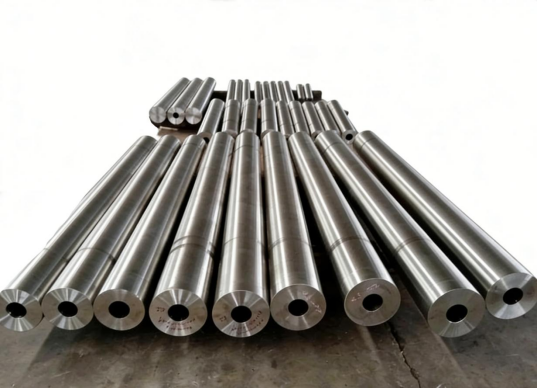
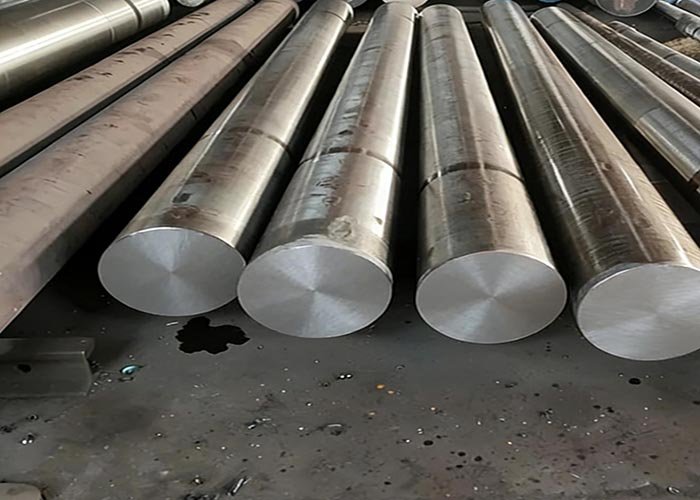
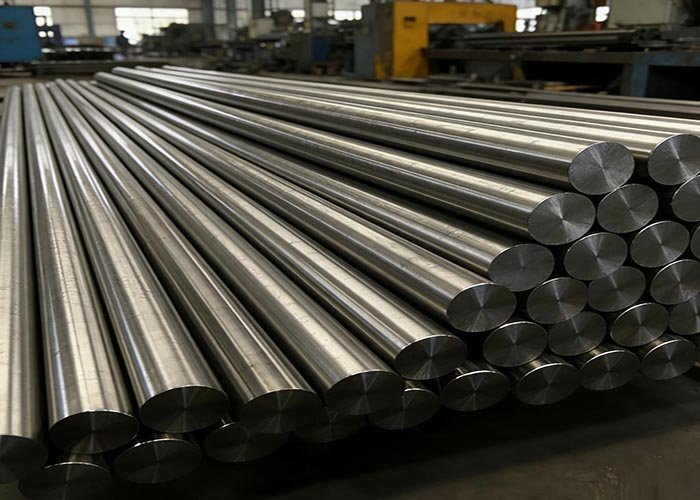
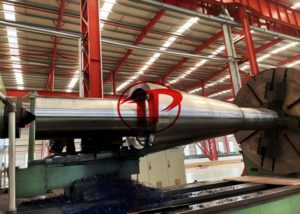
Simply put, forged titanium alloy round bars are produced by heating titanium alloy ingots and subjecting them to multiple forging stages—including breakdown, intermediate, and finishing forging—combined with heat treatment and precision processing.
2. Titanium Alloy Grades and Selection Guidelines
Based on the matrix microstructure obtained at room temperature, titanium alloys are classified into three categories: α titanium alloys, β titanium alloys, and α+β titanium alloys, designated by the prefixes TA, TB, and TC respectively.
2.1. TA Series (α-type and near-α titanium alloys)
Typical grades:TA1/TA2/TA3,TA7 (Ti-5Al-2.5Sn),TA15,
2.2. TC Series (α+β titanium alloys)
Typical grades:TC4 (Ti-6Al-4V),TC11,TC17
2.3. TB Series (β-type titanium alloys)
Typical grades:TB2 ,TB8 (Ti-15V-3Cr-3Sn-3Al)
Material Selection Recommendations:
| Application Requirements | Recommended Series | Typical Grades |
| Corrosive environments (chemical, seawater) | TA Series | TA1, TA2 |
| High-temperature components (above 500°C) | TA Series (near-α) | TA7, TA15 |
| Demanding overall mechanical properties | TC Series | TC4, TC11 |
| Ultra-high strength, lightweight structures | TB Series | TB2, TB8 |
| Aero-engine hot-section components | TC Series | TC17 |
3. Applications of Forged Titanium Alloy Round Bars
Forged titanium alloy round bars have a wide range of applications, primarily in the following high-end equipment sectors:
Aerospace Field
- Aircraft structural parts: fuselage frames, fasteners, and other critical components
- Engine components: fan disks, compressor blisks, drums, and other hot-section rotating parts
- Landing gear: load-bearing forgings
- Spacecraft structural components
Marine and Ocean Engineering
- Ship hull components resistant to seawater corrosion
- Key materials for deep-sea equipment
Chemical and Energy Sector
- Reactors, heat exchangers, seawater desalination pipelines
- Nuclear power plant heat exchange tubes
- Oil extraction equipment fittings
Medical Field
- Artificial joints and other medical devices
- Orthopedic implants
Other Fields
- Automotive lightweight components
- Sporting goods (bicycle frames, golf club shafts, etc.)
4. Main Manufacturing Process Flow for Forged Titanium Alloy Round Bars
The production of forged titanium alloy round bars from ingot to finished product generally involves the following main stages:
Stage 1: Ingot Preparation
Sponge titanium, master alloys, or pure metals are melted according to the specified composition to form titanium alloy ingots. The ingots undergo surface cleaning (via machining or grit blasting) and are tested to verify that the chemical composition meets standard requirements.
Stage 2: Cogging (Opening) Forging
The initial forging temperature for cogging is generally 150–250°C above the beta transus temperature, where the cast structure exhibits optimum plasticity. The primary purpose of this stage is to break up the cast structure and eliminate casting defects. Multiple heating cycles of upsetting and drawing-out forging are typically performed.
Stage 3: Intermediate Forging
Forging is carried out in the α+β two-phase region to further refine the grain structure and optimize the microstructure. Forging methods may include open-die forging or precision forging (also known as radial forging). The precision forging process offers advantages such as high hammer-striking frequency, high dimensional accuracy, and metal flow constrained to axial extension (which minimizes circumferential edge formation and cracking).
Stage 4: Finish Forging
Final shaping forging is conducted below the phase transformation temperature, with controlled finishing temperature to ensure the desired microstructure and mechanical properties.
Stage 5: Heat Treatment
Depending on the grade and application requirements, heat treatments such as annealing, solution treatment, and aging are performed to adjust the microstructure and properties.
Stage 6: Finishing and Inspection
- Straightening, end-cutting, and grinding
- Dimensional inspection
- Ultrasonic testing (UT) to ensure the absence of internal inclusions, porosity, and other defects
- Chemical composition and mechanical property testing
5. Our Company’s Advantages in Forged Titanium Alloy Round Bar Production
5.1 Advanced Forging Equipment: We have key machinery like open die forging presses and precision forging machines. The precision forgers produce bars with tight dimensional tolerances and smooth surfaces, and they run at high efficiency. What’s more, with precision forging, the hammers strike fast and the metal is forced to extend only axially, so we rarely get edge marks or cracks—this is something we’re proud of and it gives us an edge in the industry.
5.2 Strict Quality Management System: We’ve put in place ultrasonic testing (UT), radiography (RT), and penetrant testing (PT), plus full checks on chemical composition, macrostructure, microstructure, and mechanical properties. And importantly, we can produce and deliver to standards like GJB2218A, AMS4928, and ASTM B348, so we’re ready for military, aerospace, and export orders.
5.3 Extensive Material Portfolio: We routinely produce TA grades (TA1, TA2, TA7, TA15), TC grades (TC4, TC11, TC17, TC18), and TB grades (TB2, TB5)—most of the common ones are available, so customers don’t have to shop around.
5.4 Wide Size Range: Our production capability covers forged titanium bars from φ30mm all the way up to φ450mm in diameter, and we can also make custom dimensions to order.
5.5 Technical R&D Strength: For difficult to deform alloys like fire resistant titanium and Ti₂AlNb, the cogging stage trips up many producers—but we’ve developed proprietary processes that let us handle them smoothly. That’s hard earned expertise built up over years of practice.
6. Common Surface Defects in Titanium Alloy Round Bars and Prevention Measures
6.1 Common Surface Defects in Titanium Alloy Round Bars
Cracks
- End-face cracking: Cracking occurring at the billet end faces, typically large and common.
- Longitudinal cracking: Elongated cracking along the flow lines, often occurring at corner-rounding positions.
- Brittle cracking: Severe cracking caused by poor plasticity or excessively low finish-forging temperatures.
Laps (Folds)
- Laps are overlapping layers of metal on the surface, mostly caused by improper forging or extrusion processes. Primary causes include:
- Excessive ingot height-to-diameter ratio or residual sampling grooves from intermediate sampling.
- Formation of laps during subsequent upsetting after cracks on the forged billet are ground into deep pits.
- Sharp protrusions and pits created during auxiliary operations that are not properly ground as required.
Tearing
Transverse cracks formed by localized tearing during drawing-out deformation. The main causes are excessive single-pass reduction (exceeding 50mm per side) or excessively high reduction speed.
Internal Cracks
Single-point, continuous, or intermittent cracking occurring internally. These are difficult to detect and require macroscopic examination or ultrasonic testing to identify.
6.2 Prevention Measures
| Defect Type | Prevention Measures |
| End-face Cracking | Thoroughly remove ingot head shrinkage cavities and tail cold shuts; control deformation speed and reduction amount; ensure uniform billet end-face temperature. |
| Longitudinal Cracking | Ensure uniform temperature at billet edges and corners; avoid water cooling after forging for temperature-sensitive alloys. |
| Brittle Cracking | Strictly control finish-forging temperature; for difficult-to-deform high-temperature titanium alloys, apply low-temperature tempering at 200–300°C. |
| Laps (Folds) | Control ingot height-to-diameter ratio; promptly grind surface defects on billets; properly grind sharp corners and pits as required. |
| Tearing | Control single-pass reduction (not exceeding 50mm per side); ensure proper preheating and smoothness of hammer anvils. |
| Internal Cracks | Ensure high metallurgical quality of ingots; control drawing temperature and deformation rate for small-diameter bars. |
Additionally, during the forging process, operations must be carried out within the specified temperature range, tools should be preheated to above 300°C, and inspection and grinding should be performed after each heating cycle.
7. Dimensional Accuracy Standards for Titanium Alloy Round Bars
Dimensional Accuracy Standards
The dimensional accuracy of titanium alloy round bars is primarily governed by the Chinese national standard GB/T 39799-2021 “Titanium and titanium alloy bars and wires—Dimensions, shapes, weights and tolerances”.
Key provisions of this standard include:
| Parameter | Specification |
| Applicable Diameter Range | Titanium and titanium alloy round bars with diameters from >7.0mm to 450.0mm |
| Dimensional Tolerances | Permissible deviations as specified in the standard’s tables |
| Roundness | Degree to which the cross-section approximates a true circle |
| Length | Random lengths: 300–6000mm; fixed lengths: tolerance of +20mm |

Reviews
There are no reviews yet.