
Description
1. What is a gooseneck for top drive drilling? What role does it play in drilling operations?
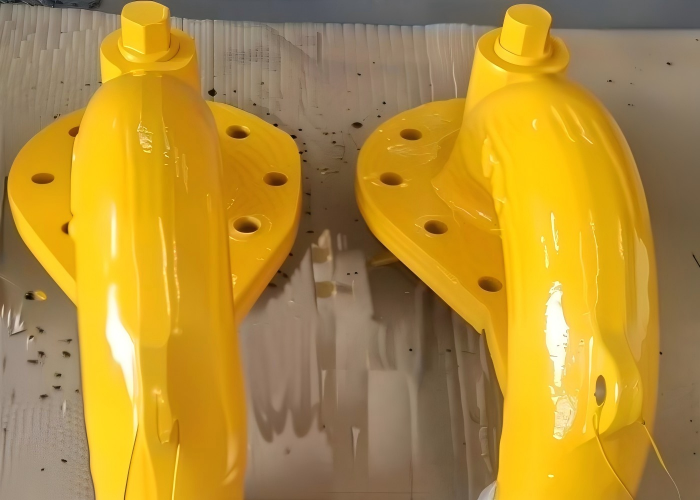
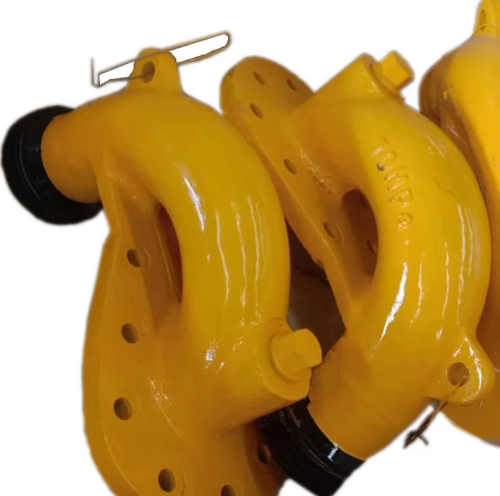
The top drive gooseneck is named for its curved, goose-neck-like shape. It is one of the key pressure-bearing components in a top drive drilling system. It is installed on the swivel support, remains relatively stationary with respect to the housing, with its lower end connected to the swivel assembly and its upper end openable for wireline operations.
Core Functions
The gooseneck performs three key functions in drilling operations:
Drilling fluid passage: The gooseneck is an important part of the drilling fluid circulation path of the top drive system. Drilling fluid enters the S-tube via the rotary hose, flows through the gooseneck, then passes through the swivel assembly into the central bore of the main shaft, and finally enters the drill string bore, completing the circulation and delivery of drilling fluid.
Pressure-bearing safety assurance: Together with the swivel assembly, main shaft, and internal blowout preventer (IBOP), the gooseneck forms the drilling fluid circulation path and is one of the key pressure-bearing components in the top drive system.
Wireline operation access: The upper end of the gooseneck can be opened to allow wireline operations, providing a convenient access path for downhole operations.
2. Common materials for forged top drive goosenecks
Forged top drive goosenecks typically use high-strength alloy steel, most commonly AISI 4145 / 4145H chromium-molybdenum alloy steel. This material is widely used for downhole drilling tools in the oil & gas industry, such as drill collars and stabilizers, offering excellent strength, toughness, and fatigue resistance.
3. What is the production process for a forged top drive gooseneck?
The production of a forged top drive gooseneck is a highly process-demanding operation, covering full-chain precision control from raw material to finished product delivery. A typical production process is as follows:
3.1 Raw material inspection and preparation
3.2 Billet heating
3.3 Die forging: Within the appropriate temperature range, forge the billet gradually into the predetermined gooseneck shape through multiple passes.
3.4 Heat treatment: Perform quenching and tempering heat treatment after forging to achieve the desired combination of mechanical properties.
3.5 Machining: Perform rough and finish machining on the heat-treated forging, including flange faces, mounting holes, and internal/external diameter processing.
3.6 Internal surface strengthening
3.7 Non-destructive testing (NDT): According to API 7K and other standards, perform 100% ultrasonic testing and surface magnetic particle inspection on the finished product to ensure no internal defects such as cracks or porosity.
3.8 Pressure test
3.9 Surface anti-corrosion treatment
3.10 Final inspection and packaging.
4. Advantages of our company’s forged top drive goosenecks
Adhering to the philosophy of “quality first, technology leadership,” our company possesses the following core advantages in the manufacturing of forged top drive goosenecks:
4.1 Advanced forging process: We have large-tonnage forging equipment and a mature die forging process system, capable of stably producing large top drive gooseneck forgings. By optimizing forging reduction and multi-pass shaping control, we ensure the forging has a dense structure, complete grain flow, and no internal defects.
4.2 Precise heat treatment control: Equipped with precise automated heat treatment production lines, quenching and tempering process parameters are accurately controllable, ensuring uniform and stable product performance and consistent hardness distribution. Differentiated heat treatment process plans can be developed for different sizes and specifications of forgings.
4.3 Full-process quality control: Implementing a fully traceable quality management system from incoming raw material inspection, forging process monitoring, heat treatment parameter recording, to machining accuracy testing and NDT. Hold-point inspections are set at critical processes to ensure quality control at each step.
4.4 Strict testing capability: Possess various testing methods and qualifications, including ultrasonic testing, magnetic particle inspection, hardness testing, tensile testing, etc., ensuring products meet the most stringent specification requirements.
5. What are the advantages of a forged top drive gooseneck compared to a cast one?
Forged top drive goosenecks offer significant technical advantages over cast ones, mainly in the following aspects:
Internal quality: Forged goosenecks eliminate as-cast porosity, gas holes, and other defects, resulting in a dense structure. Cast goosenecks may have gas holes and shrinkage porosity, affecting strength and durability.
Mechanical properties: Due to the complete grain flow, forged goosenecks have superior mechanical properties to castings of the same material, with higher strength and toughness. Cast goosenecks have relatively lower mechanical properties, coarse structure, and more defects.
Erosion resistance: Forged goosenecks have significantly improved strength and better resistance to high-pressure mud erosion, effectively preventing wall penetration. Cast goosenecks, with their loose structure, are prone to wall penetration under high-pressure mud erosion, leading to shorter service life.
Microstructure: Forged goosenecks have refined grains, complete grain flow, and good isotropy. Cast goosenecks have coarse grains and are prone to segregation and shrinkage porosity.
Reliability: Forged goosenecks are suitable for critical components under high loads and harsh working conditions. Cast goosenecks are suitable for components with complex shapes but low stress.
Applicability: Forging is suitable for curved pipes with complex shapes and can produce integral structures. Casting excels at producing parts with complex shapes and complex internal cavities.
Cost: The processing cost of forging is relatively higher, while the production cost of casting is lower, making it more economical.
6. FAQ
6.1 What are the common failure modes of a top drive gooseneck? How to prevent them?
Common failure modes
Erosion failure: Abrasive particles in the drilling fluid cause erosive wear on the internal cavity of the gooseneck at high flow rates. Studies show that the erosion rate is highest at the inner diameter of the gooseneck bend, and the maximum erosion rate increases with drilling fluid density.
Deformation failure: The gooseneck internal cavity is subjected to significant cyclic loads and pressure fluctuations during operation, which may lead to plastic deformation or accumulated damage.
Seal failure: The connection between the gooseneck and the swivel assembly is subject to long-term effects of high temperature, high pressure, and vibration, potentially leading to leakage.
Prevention measures
Surface strengthening: Surface strengthening of the gooseneck’s internal cavity can effectively reduce maximum deformation displacement.
Strict control of drilling fluid parameters: Reasonably control drilling fluid density, solid content, and flow rate to reduce the erosion rate on the gooseneck inner wall.
Regular maintenance and inspection: Regularly clean, visually inspect, and perform NDT on the gooseneck according to maintenance manual requirements to detect and evaluate wear or damage in a timely manner.
Correct installation and alignment: Ensure the installation concentricity of the gooseneck with the swivel assembly and main shaft meets requirements, avoiding local stress concentration and accelerated seal failure due to misalignment.
Choose forged products: Forged goosenecks, due to their dense material and excellent structure, have significantly better erosion and deformation resistance than castings, improving product reliability from the material source.
6.2 How to select the appropriate forged gooseneck for a top drive?
Selecting the appropriate forged gooseneck requires comprehensive consideration of the following aspects:
(1) Rated working pressure and bore size: Based on the top drive system’s working pressure rating (e.g., 35 MPa, 52 MPa, etc.) and drilling fluid displacement requirements, select a gooseneck with the corresponding pressure rating and bore size specification. Common swivel assembly sizes include 4 in/52 MPa, 3 in/52 MPa, 3 in/35 MPa, etc., and the gooseneck must match these.
(2) Compatibility with top drive model: Different models and specifications of top drives have different gooseneck interface dimensions, installation positions, and connection methods. Provide the top drive model or technical requirements during selection to ensure precise fit between the gooseneck, top drive housing, swivel assembly, and S-tube.
(3) Manufacturing process requirements: Prioritize goosenecks manufactured by forging to ensure product internal quality and service reliability. The mechanical properties and erosion resistance of forgings are significantly better than castings of the same material.
(4) Material and performance grade: Confirm the material grade (AISI 4145/4145H or other high-quality alloy steel is recommended) and heat treatment condition. Request material certificates (including chemical composition and mechanical properties) to ensure hardness, strength, and other indicators meet design requirements.
(5) Manufacturing and testing standards: Confirm that the gooseneck complies with API 7K (Specification for Drilling and Well Servicing Equipment) or relevant industry standards. API 7K establishes comprehensive design, manufacturing, and testing requirements for top drives and their critical components. Compliance means the product has undergone rigorous design review, material selection, process control, and performance testing.
(6) Internal cavity treatment requirements: Based on drilling fluid conditions, apply surface strengthening to the gooseneck’s internal cavity to extend product life. Specify special anti-corrosion or wear-resistant coatings in the technical agreement if required.

Reviews
There are no reviews yet.