

Description
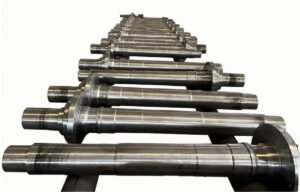
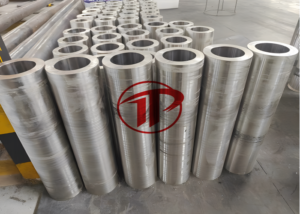
1. Brief Introduction to 4330V Hollow Forged Bars
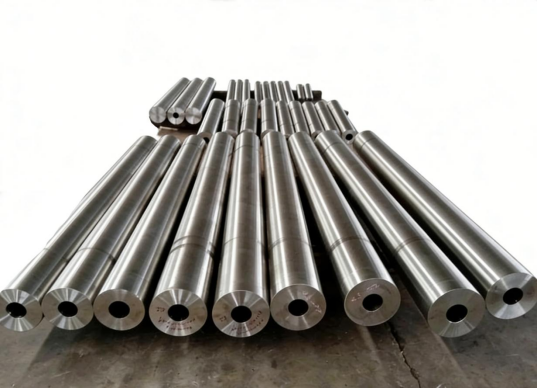
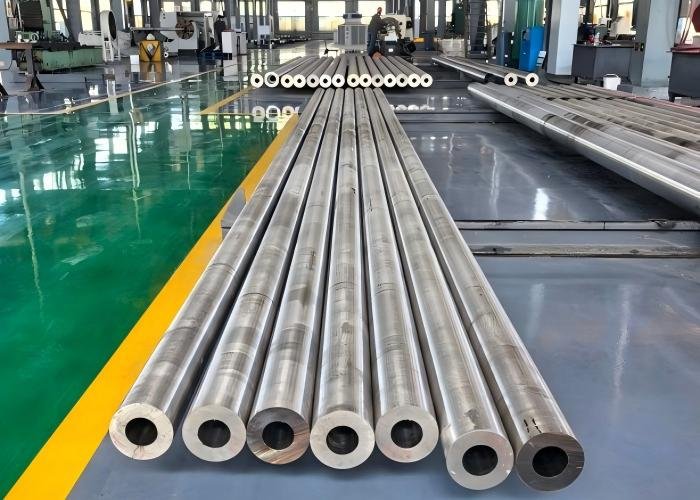
4330V hollow forged bars are usually supplied in the quenched and tempered condition—quenched, then tempered. Hardness is typically controlled at 341–388 HBW, or roughly 35–39 HRC. They combine high strength with good impact toughness, so they are well suited for conditions with high impact loads and stress concentration.
2. Typical Chemical Composition and Mechanical Properties of 4330V Hollow Forged Bars
Typical chemical composition range:
| Element | Typical Content Range (%) |
| C | 0.28–0.34 |
| Mn | 0.75–1.00 |
| Si | 0.15–0.35 |
| Cr | 0.75–1.10 |
| Ni | 1.65–2.00 |
| Mo | 0.35–0.50 |
| V | 0.05–0.10 |
| P | ≤ 0.025 |
| S | ≤ 0.015 |
Mechanical properties (typical values in quenched and tempered condition):
| Property | Typical Value |
| Yield strength (Rp0.2) | 896–1034 MPa |
| Tensile strength (Rm) | 1034–1138 MPa |
| Elongation | 13–15% |
| Hardness | 341–388 HBW |
| Impact toughness (-20°C) | ≥ 32 J |
3. Size Range of 4330V Hollow Forged Bars
OD: common range 80–500 mm
ID/bored diameter: 10–250 mm
Maximum length: single bar up to 14 m
4. Applications of 4330V Hollow Forged Bars and Common Oil Drilling Tools and Fields
4330V hollow forged bars are mainly used in working conditions requiring extremely high strength, toughness and reliability, especially in the oil and gas industry. Common applications include:
Oil drilling tools: drill pipe joints, drill collars, stabilizers, jarring tools, fishing tools, etc.
Downhole tools: components subjected to impact loads and stress concentration
Deepwater oil production equipment: key forgings under severe deepwater conditions
Aerospace: bolts, airframe structural parts, landing gear components, etc.
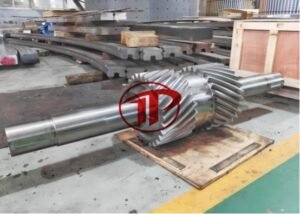
Others: power transmission shafts, gears, etc.
5. Main Process Flow of 4330V Hollow Forged Bars
5.1 Melting
Electric Arc Furnace (EAF) used in combination with Ladle Refining (LF) and Vacuum Degassing (VD) – controlling the cleanliness of molten steel very strictly to minimize the levels of gases and inclusion of nonmetallics.
5.2 Ingot Casting / Continuous Casting
Bottom pouring, or casting into a ladle filled with argon gas, followed by continuous casting method.
5.3 Preheating (before forging)
Slow preheating to 1050–1230°C to ensure uniform heating of steel.
5.4 Forging
The temperature at which forging will be started is 1065–1235°C while the temperature at which the completion of the forging will be done should not be less than 850°C.
The forging ratio is usually ≥3:1, and ≥4:1 for higher strength requirements.
Slow cooling after forging (e.g., in ash or lime) to avoid cracking.
5.5 Post-Forging Heat Treatment
Normalizing (870–890°C followed by air cooling) is normally done to remove the stresses of forging and to refine the grain size. The normalizing operation is followed by annealing (830–860°C, furnace cooling) which is done to enhance the machinability.
5.6 Performance Heat Treatment (Quenching & Tempering)
Heat to 870–880°C (heating rate ~200°C/h), hold for 2.5–3 hours, then rapidly water quench or oil quench to below 40°C. Then temper at 600–620°C, hold appropriate time, followed by water or air cooling – resulting in a tempered martensite (sorbite) structure for optimal strength-toughness balance.
5.7 Finishing
Surface turning, grinding, straightening; rough or finish machining as required.
5.8 Quality Inspection
Chemical analysis, mechanical property testing, non-destructive testing (ultrasonic testing, magnetic particle inspection, etc.).
6. What Are the Advantages of 4330V Compared with Ordinary AISI 4140/4340?
If you’re choosing between 4330V, 4140, and 4340, it mostly comes down to strength, toughness, hardenability, and cost.
4140 is the general-purpose, lower-cost option. It’s fine for ordinary structural parts. Strength usually stays below 120 KSI, hardenability is average, and toughness is just moderate.
4340 gives you more strength—up to 140–150 KSI—and better hardenability. It’s often used where high strength matters, like aerospace structural parts. Toughness is decent.
What 4330V really brings is a good balance of strength and toughness. Its hardenability is better than 4140 and about the same as 4340, maybe slightly better. Toughness is much better than 4140, especially at low temperatures. Strength can also reach 150 KSI. So for things like high-impact drilling tools or deepwater equipment, where you need strength but don’t want brittle failure, 4330V is usually the first choice..
The key difference is that at the same strength level, 4330V has significantly better impact toughness than 4140. This is mainly due to grain refinement from vanadium and optimized nickel content. When selecting 4330V at high strength levels, the reason is its better hardenability and improved CVN impact toughness. Compared with 4340, 4330V has slightly lower carbon content, but through vanadium addition and composition adjustment, it achieves a better strength-toughness match. Simply put, its strength is not low, but it is less prone to fracture.
7. Our Company’s Advantages in Producing 4330V Hollow Forged Bars
7.1 Manufacturing Capability – From Large Sizes to Fine Customization
At TIPTOP FORGING, we have industry-leading large-section production capabilities:
- lForged bar diameter: full coverage from Φ80 mm to 1200 mm
- lLength: 0.5 to 16 meters, cut-to-length on request
- lLarge forgings up to Φ6000 mm in diameter
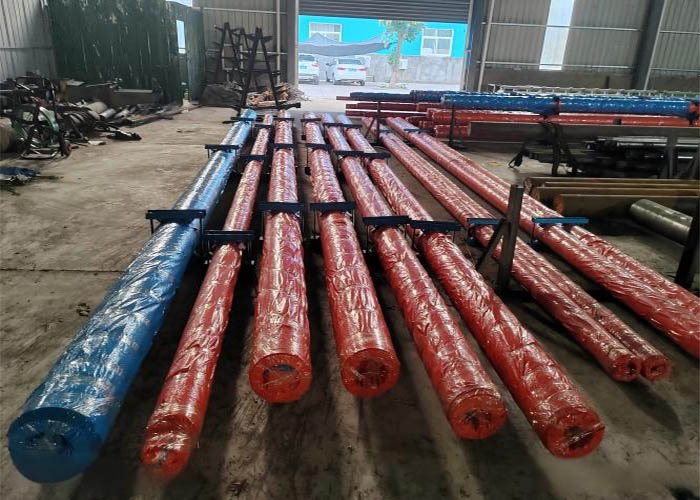
lWide range of delivery conditions: black surface, ground, turned, rough machined, finish machined, or fully machined to customer drawings
7.2 Quality Assurance – 100% NDT & International Certification
We do not use random sampling. During production, we perform three chemical checks and two post-forging UT inspections. Before shipment, every bar undergoes 100% ultrasonic testing – no white spots, cracks, or inclusions. Our facility is ISO9001 certified.
7.3 Industry Expertise – We Know Both Products & Applications
Beyond hard manufacturing capabilities, we provide deep technical support and application knowledge.
Reviews
There are no reviews yet.