Introduction
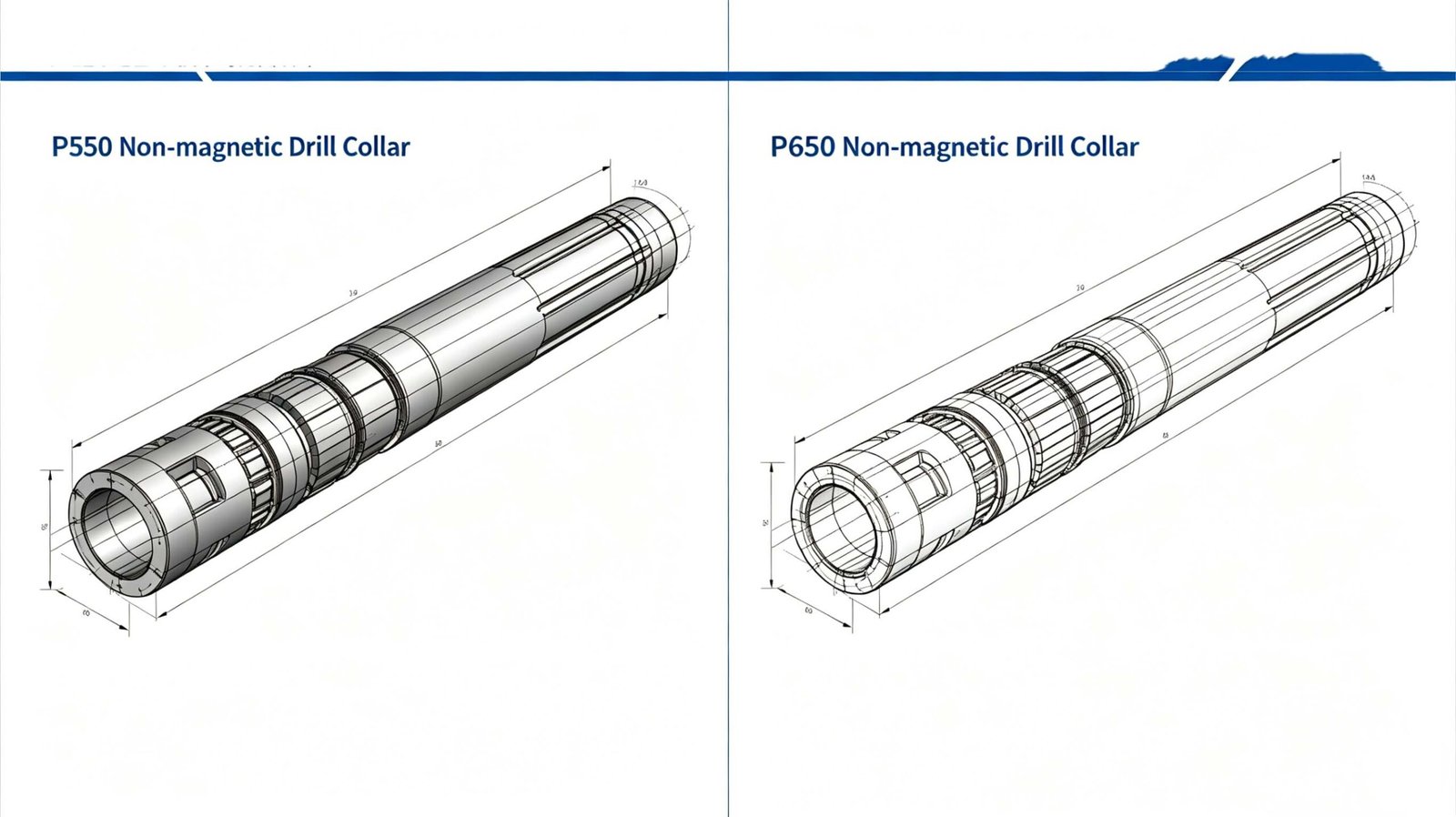
Directional drilling is a very complex process. But one of the main problems is, of course, how to choose the right non magnetic drill collar (NMDC) material for the operation so as to provide accuracy of measurements and reliability of the whole drilling operation at the same time. Out of the materials most frequently used, P550 and P650 non magnetic drill collars are considered as the most preferable MWD (Measurement While Drilling) and LWD (Logging While Drilling) etc. are the systems where these materials can be directly used. Even though they have low magnetic permeability and are able to maintain their stable performances, however, their differences in mechanical strength, fatigue resistance and corrosion performance are quite large and can highly influence drilling results especially when it comes to deep wells and complicated formations.
Here you will find a good practical guide which, by comparing P550 with P650, will enable you to decide on the right engineering solution.
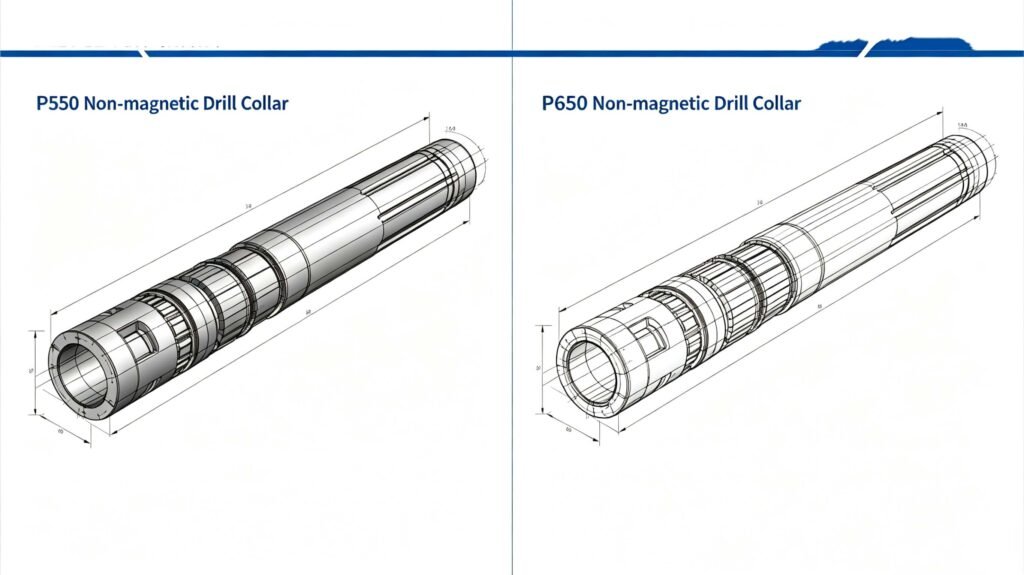
What Are P550 and P650 Non Magnetic Drill Collars?
The main function of non magnetic drill collars is to shield the magnetic field generated by the drill string so the rest of the tools are not affected and can continue to operate and provide measurements.
Both P550 and P650 are high-manganese austenitic stainless steels which were designed and developed primarily for drilling use.
Generally, P550 is a normal grade or a baseline material for production of NMDCs and is ideal for directional drilling operations under normal conditions. P650 is a superior material prime for supporting heavy loads, deeper well drilling, and highly aggressive environments.
Key Differences Between P550 and P650 NMDC
| Property | P550 NMDC | P650 NMDC |
| Yield Strength | Lower | Higher |
| Tensile Strength | Moderate | Higher |
| Fatigue Resistance | Standard | Enhanced |
| Corrosion Resistance | Good | Excellent |
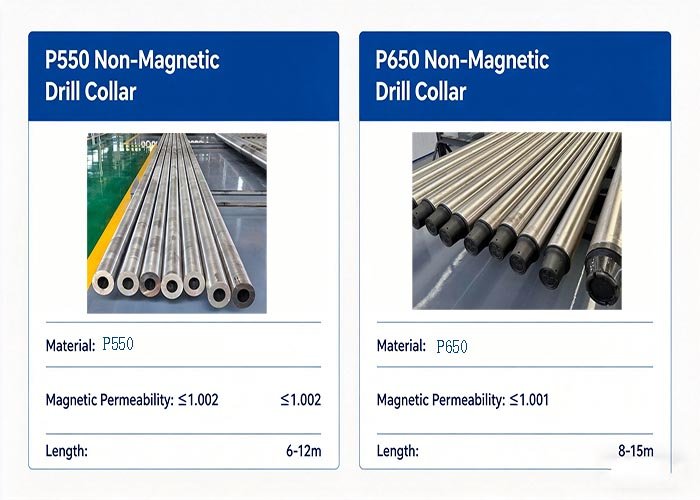
| Magnetic Permeability | μr ≤ 1.005 | μr ≤ 1.005 |
| Suitable Well Depth | Medium | Deep / Ultra-deep |
| Cost | Lower | Higher |
Performance Comparison in Real Drilling Conditions
Strength and Load Capacity
Drilling tools must be strong enough to perform reliably under conditions of high torque and axial loads, and the strength of the material will dictate their performance.
Since deep and extended-reach wells involve very complex stress situations, higher yield and tensile strengths of P650 enable it to resist these stress conditions better.
In normal cases, P550 is safe to use, however, it may not perform as well in cases of very heavy loads.
Fatigue Resistance in Cyclic Operations
Drilling collars undergo a series of loading and unloading during drilling. Fatigue is a major cause of tool breakdown as time goes by.
P650 will better resist fatigue as its compositional and processing have been carefully optimized, hence it will be a better choice for long drilling operations and frequent usage.
Corrosion Resistance in Sour Environments
Presence of H₂S, CO₂, and high salinity fluids in formations corrosion resistance plays a very important role.
In a mild environment, P550 can deal with it while in the harshest conditions, P650 is significantly superior in withstanding pitting and stress corrosion cracking, hence it can be counted on more in sour gas fields and offshore drilling.
Measurement Accuracy and Magnetic Stability
In terms of text permeability, both P550 and P650 posses ultra-low magnetic permeability, hence they cause very little interference with MWD/LWD tools.
In terms of the measurement aspect, both are practically equals.
Therefore, the deciding factor should be the mechanical and environmental requirements.
When Should You Choose P550 NMDC?
If you decide to go for P550 Non-Magnetic Drill Collar , you get the following benefit:
- Directional drilling, Ordinary
- Wells of medium depth
- Normal temperature and pressure conditions
- Low-budget projects
In such cases P550 performance is more than enough at no extra cost.
When Is P650 the Better Choice?
Switching to P650 Non Magnetic Drill Collar means you are going to utilize best possible material in a situation where:
- Very deep or ultradeep wells
- High-pressure and high-temperature (HPHT) environments
- Sour formations containing H₂S or CO₂
- Frequently repeated drills with high fatigue resistance requirements
Under such conditions, the enhanced strength and durability of P650 lead to substantial risk reductions during operations.
Cost vs Reliability: Which One Offers Better Value?
It seems P550 is more attractive economically on the surface due to its lower raw material and manufacturing costs. However, any downtime or failure of the drilling equipment contributes to the operations sensitivity.
Using a lower-grade material in high-risk environments may result in,
- Increased maintenance
- Higher replacement frequency
- Possible drilling delays
On the other hand, P650 is a significantly more costly product but it is well known for reducing the overall operational cost through higher operational reliability and longer service life.
Engineering Recommendation
The choice between P550 and P650 should not be reduced to just a matter of cost—it should consider the level of risk.
· For normal wells → P550 will be enough
· For challenging and high-risk wells → P650 is the right choice
If there is no certainty, opting for a higher-performance material will avert unexpected failures and guarantee continuous drilling operations.
Why Choose TIPTOP for Non Magnetic Drill Collars?
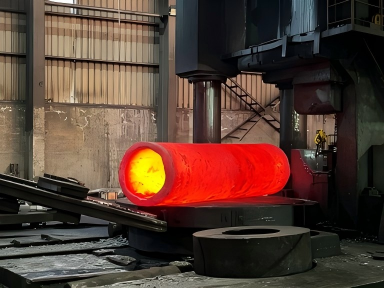
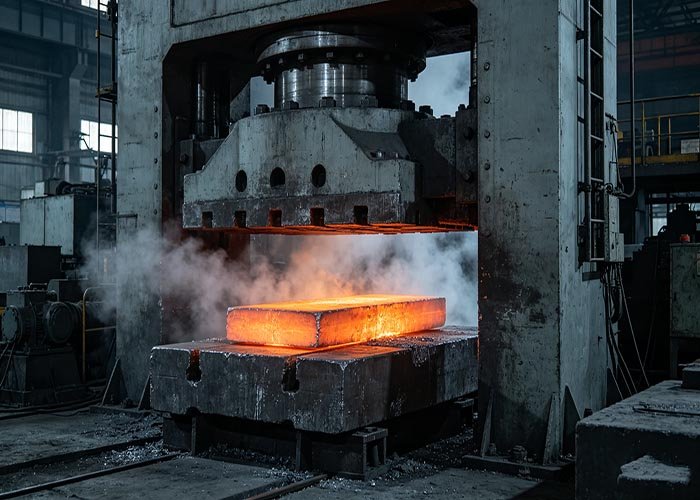
At TIPTOP, both P550 and P650 NMDCs are precision forged and manufactured under tightly controlled quality conditions.
We offer:
- Complete traceability (heat number, forging records, inspection reports)
- Certified by API SPEC 7-1 and compliant with industry standards
- Ability to deliver customized products according to the drilling conditions and design
- Successful record in worldwide drilling projects
Client assistance as well as selection of most suitable material are based on actual working conditions that our experienced engineers consider beyond just specifications.
FAQ: P550 vs P650 NMDC
Q1: Is P650 always better than P550?
Not necessarily. P650 is better for demanding environments, while P550 is sufficient for standard drilling conditions.
Q2: Do P550 and P650 have the same magnetic performance?
Yes. Both materials maintain ultra-low magnetic permeability and provide reliable measurement environments.
Q3: Which material lasts longer?
P650 generally offers longer service life due to higher strength and better fatigue resistance.
Q4: How do I choose between P550 and P650?
The choice depends on well depth, pressure, temperature, and corrosion conditions. For complex wells, P650 is usually recommended.
Get Expert Advice for Your Drilling Project
Selecting the wrong NMDC material can lead to measurement errors, tool failure, and increased operational costs.
Tell us your drilling conditions, and our engineers will recommend the most suitable P550 or P650 solution for your project.