
Description
1. Introduction to Riser Forgings
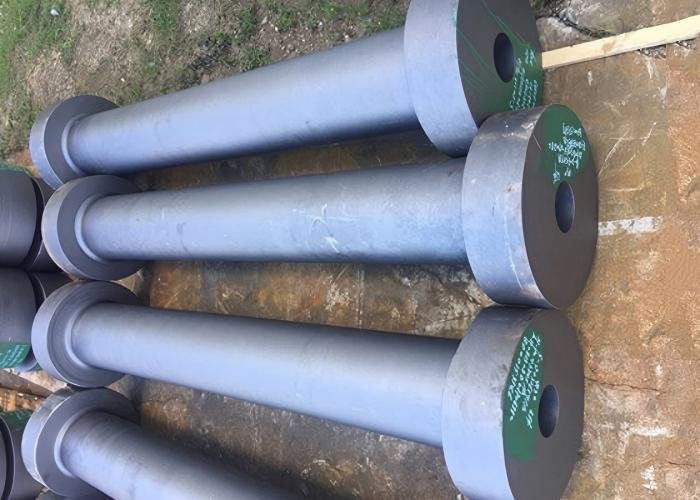
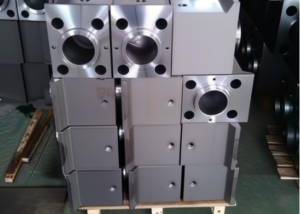
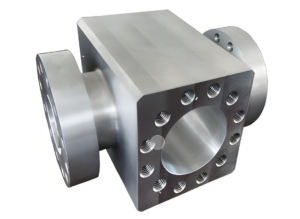
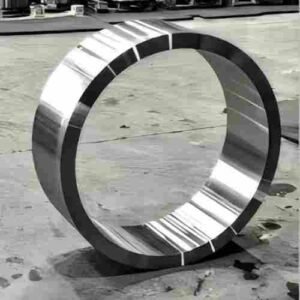
A riser is a short, stocky shaft-type or pipe-type forging with flanged or threaded connections. Its core functions are height compensation, connection transition, and spatial adaptation, enabling precise alignment between equipment, piping, or shafting components that have different heights or connection formats. They are typically stepped, flanged, or threaded, with one end fixed and the other connected. Height ranges from a few dozen millimeters to several hundred millimeters. They are formed by open‑die or closed‑die forging, followed by heat treatment, machining, and non‑destructive testing before delivery.
2. Applications of Riser Forgings
2.1 Critical Applications in Oil & Gas Wellheads and Pipelines
Wellheads and Christmas trees: Elevation flanges installed on wellhead equipment and short riser nipples attached to Christmas trees serve to raise valves or sensors to operating height or to avoid interference. Risers used in subsea trees have wall thickness and material selected based on sea current impact loads.
High‑pressure transmission pipelines: At pipeline slope change points and valve manifold inlets/outlets, height compensation is often needed. The most common onsite issue is misaligned flange bolt holes, which can be solved by a single turning pass of the riser on site. For subsea pipelines transitioning from horizontal to riser sections, fatigue calculation is required for the risers used.
2.2 Long‑Term Durability in Power Boilers and Turbine Shaft Systems
Thermal power main steam piping: Elevation transition from boiler outlet to turbine inlet commonly uses F91/P91 material, with wall thickness designed for creep resistance. For nuclear power RPV (reactor pressure vessel) top‑head flanges, the risers must pass combined fatigue and impact tests per ASME NB subsection.
Turbine shafting: Connecting riser nipples between generator and turbine transmit torque while ensuring alignment, with coaxiality requirement within 0.05 mm. Finish machining is completed on CNC vertical lathes.
2.3 Customised Corrosion‑Resistant and Hygienic Solutions in Chemical & Fluid Handling
Refinery tower nozzles: Atmospheric/vacuum distillation tower side‑cut outlets use risers to raise valves for easy maintenance. Acid/alkali media lines mostly use 316L or duplex stainless steel; for high‑temperature concentrated sulphuric acid, 904L or even C‑276 is required, priced by kilogram.
Pharmaceutical and food lines: Where cleanliness grades are high, the inner wall of the riser must be mirror‑polished (Ra ≤ 0.4), material 316L, welded ends to pass PT, and flange sealing surfaces free of scratches. For reactor inlet/outlet risers, quick‑release clamp connections are often required for CIP cleaning.
Pump inlet/outlet connections: High‑pressure pump outlets generate significant vibration; riser wall thickness should be increased by 30%, and flange bolt preload must be calculated for anti‑loosening, with anti‑vibration pipe clamps often added onsite.
3. Commonly Used Materials for Riser Forgings
Chromium‑molybdenum alloy steels (high strength / heat resistance)
4130 / 4140: Used in oilfield tools and high‑strength shafting, offering fatigue and impact resistance.
F22 (2.25Cr‑1Mo) / F91: For high‑temperature and high‑pressure (>300°C) creep‑resistant applications, used in thermal power and refining.
4. Advantages of Riser Forgings over Ordinary Castings
4.1 Superior Mechanical Properties (Key)
Casting involves pouring liquid metal into a mould for cooling; shrinkage cavities, porosity, and inclusions are almost inevitable, especially in heavy sections – internal defects are easily detected by NDT. Forging, by contrast, uses a forging press to repeatedly consolidate the ingot, breaking up the cast dendritic structure and welding internal porosity. The resulting dense structure allows UT to achieve the highest grades, which castings cannot match.
Strength data from the field consistently show that, with the same material, forged parts have tensile and yield strengths 30%–50% higher, and impact energy often doubles. The most critical difference is in fatigue resistance – under pressure fluctuations and pipeline vibration, forged risers withstand roughly twice the cycle life of cast ones, and that determines whether cracks initiate.
4.2 Reliability and Safety
No casting defects: inherently avoids porosity, inclusions, and cracks common in castings, significantly reducing failure risk.
Consistent performance: excellent batch‑to‑batch uniformity and predictability, suitable for safety‑critical components.
4.3 Machining and Service Performance
Better machinability: uniform structure with no hard/soft spots, higher cutting efficiency and lower tool wear.
Wear and impact resistance: under heavy loads, vibration, and shock, forgings are less prone to chipping or excessive wear.
High dimensional accuracy: smaller machining allowance, less subsequent processing, and easier control of geometric tolerances.
5. Manufacturing Process of Riser Forgings
- Raw material inspection: Round bars or ingots are received; chemical composition verified by spectrometer and UT to ensure no initial defects.
- Cutting: CNC saws cut to size, ensuring accurate billet weight and length.
- Heating: Gas or induction furnaces heat to 1100–1250°C (hot forging) with uniform soaking.
- Forging forming: Open‑die or closed‑die forging with forging ratio ≥4:1 (critical parts ≥5:1) to shape and optimize metal flow lines.
- Post‑forging treatment: Slow cooling or normalising to relieve forging stresses and prevent cracking.
- Heat treatment: Quenching + tempering, normalising, or solution treatment per material grade to achieve specified hardness and strength.
- Machining + NDT: CNC machining for dimensions and surface finish; 100% UT/MT to ensure no internal or surface defects.
- Final inspection & marking: Dimensional, hardness, and mechanical property checks; marking of heat number, material grade, and standard; quality certificate issued.
6. Our Company’s Advantages in Producing Riser Forgings
6.1Manufacturing Capability
- 15+ years of forging experience; risers are a mature product covering oil & gas, power, and chemical industries.
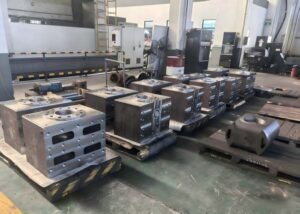
- Both open‑die and closed‑die production lines, capable of producing non‑standard large‑diameter, short‑stocky, and stepped profiles.
- Forging ratio ≥4:1, complete metal flow lines, grain size finer than grade 5.
- Full‑sequence heat treatment (normalising, quenching, tempering, quenching‑and‑tempering) to precisely control hardness and strength as per customer requirements, ensuring fatigue and impact performance.
6.2 Quality Control
100% incoming material re‑inspection (spectrometer + UT); substandard material not accepted.
In‑process NDT: UT after forging, MT after machining; additional RT/PT for critical parts – zero‑defect delivery.
Full traceability: heat numbers, process parameters, inspection reports, dimensional records all archived; complete quality certificate.
Applicable standards: API 6A, ASTM A182, GB/T 12228, etc.; third‑party inspection supported.
6.3 Delivery and Service
Delivery lead time: 30 days for small batches, 60 days for large batches; expedited scheduling possible for urgent orders.
Non‑standard customisation: wall thickness and material selection optimised based on operating conditions and drawings, balancing performance and cost.
After‑sales support: installation guidance, on‑site alignment assistance, and 24‑hour response to quality issues; rework or replacement arranged upon confirmation to avoid project delays.
7. Applicable Standards for Riser Forgings
- API 6A / 16A: Wellhead equipment structural and performance requirements.
- ASTM A105/A105M: Carbon steel forgings for piping and flanges (general purpose).
- NACE MR0175: For sour oil and gas fields – resistance to HIC/SSC.
- UT: ASTM A388 / GB/T 6402
- MT: ASTM A275 / JB/T 4730

Reviews
There are no reviews yet.